
Liam H.
Jun 26, 2026
•11 minutes
PBT Keycaps: The Complete Buyer's Guide
PBT keycaps explained: material science, PBT vs ABS, dye-sub legends, Cherry profile sound, and how to pick the right in-stock set for your build.
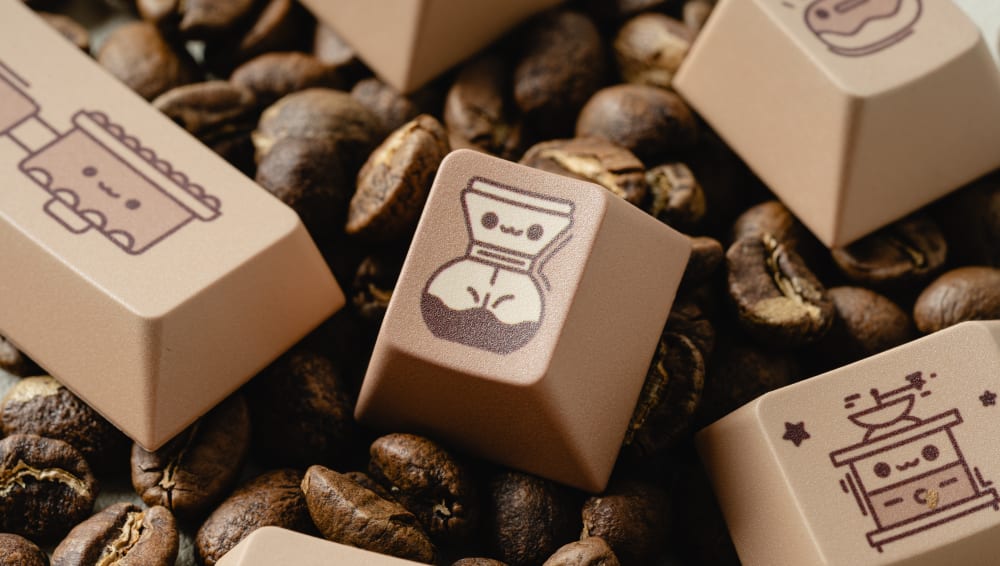
Closeup of Coffee Shop Keycap
PBT keycaps are the default recommendation for most enthusiast builds for one reason that gets repeated everywhere and explained almost nowhere: the material itself behaves differently than ABS at a molecular level.
Most guides stop at "PBT doesn't shine" and call it a day, which leaves you with a slogan instead of an understanding. The point of this guide is to connect what PBT actually is to how it sounds and feels in a build you'd actually own.
What Exactly Is PBT? (The Material Science in Plain English)
PBT stands for polybutylene terephthalate, a semi-crystalline thermoplastic in the polyester family. That word "crystalline" is the part competitors skip, and it's the part that explains everything else.
When a polymer is crystalline, its molecular chains pack into ordered, repeating regions instead of lying around in a random tangle. ABS, by contrast, is amorphous: the chains never organize themselves. That ordered structure is why PBT resists the slow polishing effect that turns ABS keycaps glossy on the spots your fingers hit most. The surface doesn't smooth out into a shine the way an amorphous plastic does. If you want the deeper breakdown of how this plays out across our sets, we wrote a full piece on what Kinetic Labs PBT keycaps are made of.

Plastic Science
Why crystallinity matters for keycaps
The crystalline regions act like internal scaffolding. They give PBT a higher melting point and better resistance to wear, which is exactly what you want from a part you're going to hammer thousands of times a day for years.
Melting point, warping, and the 'no shine' benefit
PBT melts around 220 degrees Celsius while ABS softens and deforms at far lower temperatures, roughly 105 degrees Celsius. You're obviously not cooking your keyboard, but the same property that raises the melting point also makes PBT more dimensionally stable under everyday heat and friction. A keycap that doesn't soften under your fingertips doesn't polish into a gloss patch either. The "no shine" benefit and the warp resistance are the same physical trait viewed from two angles.

Plastic Melting
Wall thickness and density
Every Kinetic Labs PBT keycap set is molded to 1.50 mm walls. That number matters more than people think. A thicker, denser keycap wall has more mass, and more mass changes how the cap rings when a switch bottoms out.
Here's the part that breaks the myth: more mass does not automatically mean a deeper, "thockier" sound. A thicker, stiffer wall actually tends to raise the resonant frequency of the cap, which pushes the keypress toward a higher, sharper note compared to a thin, flimsy 1.2 mm ABS cap that flexes and damps itself. PBT is not a guaranteed ticket to deep sound. It's a denser canvas, and the rest of your build decides what gets painted on it.

Hippo V2 PBT Keycaps
PBT vs ABS Keycaps: An Honest Side-by-Side
Neither material wins outright. Anyone telling you PBT is simply better is selling you a headline. The honest comparison is about trade-offs, and we've covered the colorway-specific side of this in our GMK vs PBT keycaps breakdown.
Shine, texture, and feel over six to twelve months
This is where PBT earns its reputation. Run a set of ABS caps for six to twelve months of daily use and the high-traffic keys (your E, your spacebar, your WASD cluster) start to develop a glossy sheen as the surface polishes. PBT keeps its matte, slightly textured face far longer because the crystalline surface resists that polishing. If you hate watching your keys go shiny, this alone settles the PBT vs ABS keycaps debate for you.
Sound signature differences
PBT tends toward a higher-pitched "clack" and ABS toward a lower "thock," and the reason traces back to material and wall structure. ABS is a softer, more damping plastic that absorbs more of the impact energy. PBT is stiffer and rings a little brighter. These are tendencies, not laws. As we've written before, keyboard sound is nearly impossible to predict from one variable, and keycap material is only one piece of it.

Matcha PBT Keycaps
Weight, warp resistance, and color stability
PBT is dimensionally stable and shrugs off heat, but it's genuinely harder to double-shot in vibrant, saturated colors, which is why so many bold, glossy colorways live in the ABS world. PBT legends are usually applied through dye-sublimation, where the ink is fused into the plastic rather than sitting on top. That means a dye-sub legend physically cannot wear off the way a pad-printed legend rubs away.
When ABS is actually the right choice
ABS isn't the loser here. If you want GMK's deep, glossy colorways, the saturated palettes that double-shot ABS does best, or maximum shine-through for an RGB backlit build, ABS is the correct tool. PBT's matte surface and dye-sub process don't light up the same way. Pick the material for what you actually want out of the build.
Legend Manufacturing Methods: Dye-Sub vs Double-Shot on PBT
Legend method gets conflated or skipped in most guides, and it's one of the more important things to understand before you spend money. We dig into it further in our guide on what to look for when buying mechanical keyboard keycaps.
How dye-sublimation works
Dye-sublimation uses heat to turn solid dye directly into a gas, which then permeates and bonds into the surface layer of the PBT. The legend becomes part of the plastic rather than a layer of ink resting on it. There's no raised edge, no painted-on feel, and crucially no way for the legend to scrape off. All Kinetic Labs PBT keycap sets use dye-sublimation legends.

Arctic PBT Keycaps
Double-shot PBT and its trade-offs
Double-shot PBT exists, and it's a real, durable method: two separate plastic shots mold the legend and the cap body as physically distinct pieces, so the legend goes all the way through. The catch is cost and color. The extra molding step is more expensive, and PBT's matte, semi-crystalline surface limits how vibrant a double-shot legend reads on darker colorways. The legend can look muted where the same approach on ABS would pop.
Why dye-sub is the sweet spot
For most enthusiasts, dye-sublimation on PBT hits the right balance: permanent legends, a clean matte surface, sharp text, and a price that doesn't balloon. You get the durability argument for PBT without paying the double-shot premium or fighting its color limitations.
Keycap Profiles: How Cherry Profile PBT Shapes Sound and Feel
This is the section most product pages and comparison posts pretend doesn't exist. Profile changes the typing angle and the air chamber sitting above your PCB, and that changes both feel and acoustics.
A quick profile primer
Profile is the height and sculpt of the keycaps:
- Cherry: short and sculpted, a low typing angle, currently the most popular enthusiast profile.
- OEM: taller than Cherry with a similar sculpt, the common stock profile on prebuilts.
- SA: tall, rounded, and spherical, known for a deep, booming sound.
- DSA: low and uniform with a flat spherical top, the same height across every row.
Every Kinetic Labs PBT keycap set uses standard Cherry profile. It sits lower than OEM, which most typists find comfortable and which keeps the sound chamber above the switch relatively compact.
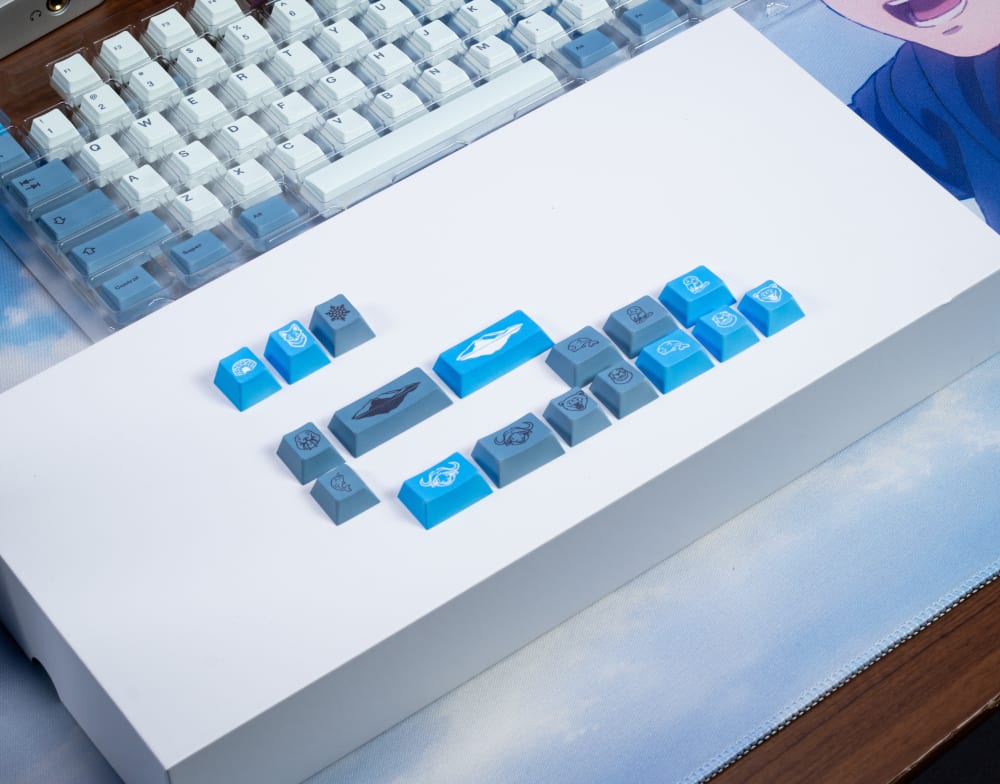
Cherry Profile Novelties for Arctic PBT Keycaps
Why standard Cherry profile is the most build-compatible PBT option
Cherry profile is the de facto standard for custom builds, so a Cherry profile PBT set drops into the widest range of keyboards without surprising you on ergonomics or aesthetics. It's the safe, sensible default, and it's why we standardized on it.
How profile height interacts with plate material
Here's where the build context turns into a real decision. A polycarbonate plate already softens and rounds off the sound on its own. Pair that with thick 1.50 mm Cherry profile PBT and you won't over-damp the board, because the relatively low, dense caps keep things from going muddy. Swap to a brass plate and the calculus flips: brass is stiff and bright, and Cherry profile PBT on brass gives you a crisp, higher-pitched result. Aluminum sits in the middle. The keycap is one input. The plate is another, and they push against each other.
What Makes PBT Keycaps Sound Better (or Worse) in a Real Build
PBT keycaps don't have a sound. They have a tendency, and the rest of the board decides whether that tendency shows up as something you like.
The same 1.50 mm PBT cap behaves completely differently depending on what's underneath it. Let me give you three builds I'd actually expect to hear differently.
The role of keycap thickness
A 1.50 mm wall is stiff and has real mass. Drop it onto a hollow, flexy budget board and the thicker cap can actually clean up some of the rattle by adding mass to each keystroke. Put the same cap on a well-tuned board and it contributes a fuller, more solid impact than a thin 1.2 mm cap would. Thickness raises the floor on sound quality, but it doesn't override everything else.
Switch spring weight and actuation
A 45 g linear bottoms out softer and produces a lighter, higher tone through the cap. A 67 g tactile slams home harder and drives more energy into the keycap and plate, which reads as a heavier, more pronounced impact sound. Same PBT cap, different switch, genuinely different acoustic result. If you're chasing a specific sound, the switch weight is doing as much work as the keycap.
Foam, gaskets, and PCB flex
Three concrete scenarios:
- 1.50 mm PBT on 45 g linears, gasket-mounted polycarbonate board with case foam. Soft, rounded, marshmallow-leaning. The PBT's brighter tendency gets reined in by the flexy mount and the foam, landing somewhere deep and muted.
- The same caps on 67 g tactiles, top-mounted aluminum board, no foam. Crisp, loud, and higher-pitched. The stiff mount and heavier switches let the PBT's brighter character run free.
- The same caps on 62 g linears, brass plate, half-plate flex cut. A bright, pingy clack up top with a touch of give underneath. Brass pushes the pitch up; the flex cut adds a little softness.
Three builds, one keycap, three sounds. That's the whole lesson. "Do PBT keycaps sound better" only has an answer inside a specific build.
The Advantages of PBT Keycaps: A Summary for Real Use
Pulling it together, here's what PBT actually buys you in daily use.
Durability and legend longevity. PBT resists wear, and dye-sublimated legends are fused into the plastic so they don't rub off. You get years of use without polished keys or fading text.
Texture that's designed in, not accidental. Every Kinetic Labs PBT keycap set has a slightly textured surface. That texture improves grip, masks finger oils better than a glossy face, and reduces the audible scrape of a finger sliding between keys. It's a small ergonomic and acoustic win you notice once you've used it.
Dimensional stability. No warping on a hot summer desk and no softening under heavy use, thanks to that high melting point and crystalline structure.
Colorfast. PBT colors hold up under UV and don't yellow or fade the way ABS can over time.
Kinetic Labs PBT Keycap Sets: What's Available Right Now
Every set shares the same baseline: 1.50 mm walls, standard Cherry profile, dye-sublimation legends, and a slightly textured PBT surface. The colorway and key count change. The quality floor does not. You can browse the full lineup in our keycaps category.
Matcha PBT Keycaps (in stock)
A soft green-and-cream colorway with 175 total keys, currently in stock at $79.99. The coverage is wide enough for most layouts including extra function rows, and the muted green pairs well with light wood or white cases. Grab the Matcha PBT keycaps if you want a calm, earthy desk.

Matcha PBT Keycaps on Desk
Coffee Shop V2 PBT Keycaps (in stock)
A warm cream-and-brown set, also 175 keys, in stock at $79.99. It leans cozy and neutral, the kind of palette that disappears into a clean setup and lets your switches and case do the talking. The Coffee Shop V2 PBT keycaps are the pick for a warmer, low-contrast build.

Coffee Shop V2 PBT Keycaps on Keyboard
Why these ship without group-buy waits
Most of the keycap hobby still runs on group buys, where you pay up front and wait months, sometimes years, to find out what you actually got. Kinetic Labs PBT sets sit in stock and ship now. You buy the set you want, when you want, and you already know the exact spec. We explain that model more in our piece on Kinetic Labs PBT keycaps.
How to Choose the Right PBT Keycap Set for Your Build
A short, practical framework so you don't overthink it.
Compatibility checklist
- Layout: a 169 to 175 key set covers the common layouts, TKL, 65%, 75%, and full-size, and the higher counts include ISO and extra function row keys.
- Stem cross: all of these are MX-compatible cross stems, the standard for custom mechanical switches. If your board takes MX switches, these fit.
- Row coverage: check that the set includes the specific modifier and bottom-row sizes your layout needs before buying.
Colorway and aesthetics
Match the set to your case color, your switch visibility (shine-through is not PBT's strength, so lean into the cap color itself), and your desk mat. A muted green like Matcha reads differently on a black aluminum case than on a white one. Hold the colorway against your actual setup, not a product render.
Budget framing: $45 vs $79.99
Treat the price difference as coverage and colorway, not quality. The $45 Bunny sets (when restocked) and the $79.99 Matcha and Coffee Shop sets are all 1.50 mm PBT with dye-sub legends. You're paying for key count and the specific colorway, not for a better plastic. Both tiers give you the same durable, textured, warp-resistant cap. For more on sorting through options, our keycap buying guide walks through the rest.
Frequently asked questions
What is PBT for keycaps?
PBT for keycaps is polybutylene terephthalate, a semi-crystalline thermoplastic used to mold keycaps. Its ordered molecular structure gives it a high melting point near 220 degrees Celsius, strong wear resistance, and a matte surface that resists the shine ABS develops over time.
Is ABS or PBT better for keycaps?
Neither is universally better. PBT resists shine, warps less, and holds dye-sublimated legends that won't rub off, making it the better daily-use default. ABS double-shots into more vibrant, glossy colorways and lights up better for RGB backlighting, so it wins for bold aesthetics like GMK sets.
Do PBT keycaps sound better?
PBT keycaps don't sound better on their own. Thicker 1.50 mm PBT tends toward a brighter, higher-pitched clack, but the actual sound depends on switch weight, plate material, mounting style, and foam. The same PBT cap can sound deep and muted on a gasket-mounted polycarbonate board or crisp and loud on a top-mounted aluminum one.
What are the advantages of PBT keycaps?
PBT keycaps resist shine and wear, hold dye-sublimated legends that don't fade, stay dimensionally stable under heat, and don't yellow under UV like ABS. The slightly textured surface also improves grip and masks finger oils, which is why PBT is the common recommendation for long-term daily use.
Are thick PBT keycaps always thocky?
No. Thicker, denser PBT walls add mass but also stiffness, which tends to raise the cap's resonant frequency toward a sharper note. A thick PBT cap only sounds deep if the rest of the build, soft plate, foam, and a flexible mount, pushes it that way.